
Rail Revive - Memories of the Llangollen to Corwen Railway Line
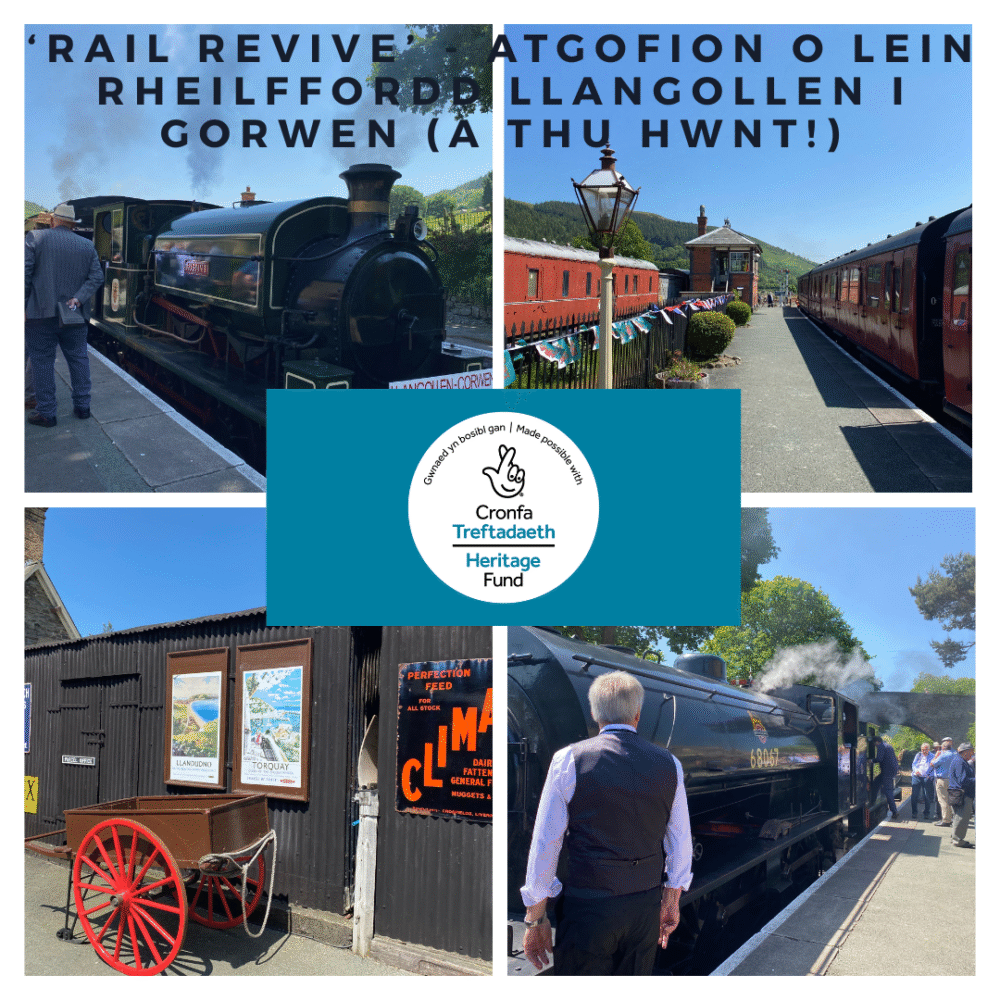

Index
Introduction / Rhagymadrodd

Using money raised by National Lottery players, the National Lottery Heritage Fund supports projects that connect people and communities with the UK's heritage. Rail Revive has been made possible with the National Lottery Heritage Fund. Thanks to National Lottery players, we have been able to create this book of community memories for public viewing and education. If you require a Welsh language transcript of this book, please contact info@bookofyou.co.uk
Welcome to the Rail Revive Community Book / Croeso i Lyfr Cymunedol 'Rail Revive'
The Story and the People / Y Stori a'r Bobl

The idea behind this project was to create a Community Book with the help of the Llangollen Railway Trust to showcase the rich history, scenic beauty and cultural significance of the railway. The multimedia format enables us from those who are an integral part of its story. Some of these are no longer with us but this book enables them to share in telling the story. The book narrates captivating stories and anecdotes from the railway's past, transporting readers back in time with sights and sounds of the railway, interviews with railway personal and volunteers as well as visitors, who all offer personal insights and emotional connections with the reader, fostering a sense of nostalgia and curiosity.
We also include some film currently held by the railway that has not been included elsewhere due to it not having the correct platform. We have created new film and audio history and it can now be viewed on a range of devices including computers, tablets, laptops and smartphones.
Introduction to Bob Gwynne / Cyflwyniad i Bob Gwynne

Bob Gwynne began volunteering on the Llangollen Railway as a teenager and over the years, has worked or volunteered there on and off, due to him living some distance from the railway. He worked at the National Railway Museum for a number of years and when his career here was coming to an end, he heard about a post funded by SPF (Shared Prosperity Fund) which would suit him perfectly. Because he knew a lot about sustainability, coal substitutes, LED lighting, insulation, solar panels, hydro electric and in general looking towards a more green future, he realised that with his experience and knowledge he could make a real difference at Llangollen. Not only is it 'green' but it also saves money which can then be reinvested into the project. Over one afternoon in April 2024, Bob gave his time to talk to Julie and Dilwyn about the history of the Llangollen line, the people who have worked on it alongside some fascinating stories.
Bob Gwynne Remembers Part 1 / Bob Gwynn yn Cofio Rhan 1
Bob Gwynne Remembers Part 2 / Bob Gwynne yn Cofio Rhan 2
Bob Gwynne Remembers Part 3 / Bob Gwynne yn Cofio Rhan 3
Bob Jaques

Bob Jacques had always been interested in railways, having been a 'trainspotter' since childhood. He even has a signal in his garden today.
In 1982 he became a hotel owner in Llangollen, having moved there from London where he previously worked in IT. He ran the business for some years, and made both the railway and beautiful surrounding countryside a major attraction for visitors to the hotel. He worked extensively with a group of Londoners who owned the 'Berwyn Bell' and they ran all sorts of activities there, including 'wine and dine' events on the train (the carriages were very luxurious, in an 'Orient Express' style) and on Saturday nights, they would offer a trip from the hotel to the station by limousine/Ford Dorchester, sometimes in period dress. The station occasionally ran 'Brief Encounters' events too. The events were initially organised by volunteers, but as soon as these events became subcontracted, sadly the costs escalated and it became more and more difficult to make income from the railway.
Bob feels that the nostalgia evoked by the railway is really significant. He has many memories, including the time the Flying Scotsman would visit. On the final time it came to Llangollen, it was derailed and had to be transported home by road which caused great difficulties when it arrived at traffic lights and navigating T junctions. There is a apocryphal story that it received a parking ticket but this can't be verified!
The difference between Llangollen railway is that the engines were reconstructed from other heritage engines.
People have been very generous with both time and money. Back in the day, there were over 300 volunteers working on the railway, but now there are just 180, although there is a volunteer recruitment officer whose job it is to find more.
Bob undertook a great deal of work in the early days for which he was rewarded with £3,000 worth of shares in the former company.
John Rutter and the American train from China / John Rutter a'r trên Americanaidd o China

John Rutter is a real expert on the engines themselves.
He still lives quite far from Llangollen but thinks nothing of the travelling - due to his passion and enthusiasm. Before his last move, he travelled around 157 miles each way every weekend to be at the railway.
Pictured is an American train bought and shipped from China by Derek, another major enthusiast.
John Rutter's commitment and that of the enthusiast Derek in bringing this great American train from China are just two examples of the attitudes that have made the Llangollen Railway what it is today.
John says that so many other organisations seem to be run by about 10% of their group who do all the work with the other 90% as "hangers on" but, at Llangollen, the reverse is true with the vast majority - 90%+ - all doing their bit!
John Mason's Book about the Corwen Station Project / Llyfr John Mason am Brosiect Gorsaf Corwen
Across the Generations - Seana McGarry / Ar Draws y Cenedlaethau - Seana McGarry

Seana McGarry was 21 years old at the time of the interview in summer 2024. She has been coming here for many years from Donegal where she lives since she was a child, coming on holiday with her parents. Originally it was to see the Thomas the Tank Engine events and then she became interested in steam trains generally.
Seana enjoys travelling on the train carriages. She has been on the footplate, having driven a diesel engine and she has alo ridden on the Thomas footplates.
She remembers always liking trains. Llangollen was the first station where she ever saw a standard guage railway. Before that, she had only seen smaller ones. Family holidays were planned around the railways. Her parents weren't as enthusiastic as her as it was her obsession and she would be happy to spend all day on the railway.
She will always try to go to as many events as possible. Her favourite event in 2024 was the Steam Gala at the end of March. This involved a rover ticket with different steam locomotives running for different things. The two main ones went as far as Corwen and then there was the Berwyn shuttle too.
She has two favourite memories. The first was when she was very young, she came off the train at Carrog and the station was closing, so she was taken into the shop by a member of staff who said she could have anything she wanted from the shop. She remembers she chose a Thomas the Tank Engine Take and Play, a train that she didn't have at the time - Donald.
Her second memory was around the age of 5 or 6 when she lost her favourite yellow blanket somewhere around her hotel. She was distraught. The person who was the Fat Controller on this day heard about it and was heartbroken, so he got another blanket and took it to Thomas, Percy and Donald. He said the trains had clubbed together to get the blanket. She had had no sleep for 2 nights but this night, she slept through for the first time. The Fat Controller told her a robin had come and told him about her losing the blanket.
Seana is currently studying drama and music at University but would love to do a degree in Railway Engineering in future.
Santa and Mince Pie Specials 2024 / Siôn Corn a Mins Pei Arbennig 2024
Interview with Dave Owen / Cyfweliad gyda Dave Owen

Joanne Crompton
Railway Man's Headstone / Carreg Fedd Dyn y Rheilffordd

This is the headstone of a proud Engine Driver, Owen Owen, who died on 6th April 1972, aged 29. We were made aware of it when interviewing some of the participants in this book and they remembered it had a wonderful inscription relating to his role. Our staff were able to locate the stone and the inscription reads:
"His last drive is over, death has put on the break (sic)
His soul has been signalled, its long journey to take
When death sounds its whistle, the steam of life falls
And his mortal clay shunted till the last trumpet calls."
Other Nearby Stations and Lines / Gorsafoedd a Llinellau Cyfagos Eraill
North Wales has a strong history of steam railways and we also include here some films that formed part of an unfinished series of oral history films featuring the reminiscences of John Roberts, a former relief signalman who worked the Ruabon - Barmouth line in the 1950s and 60s. The films were recorded at Llanuwchllyn Signalbox, Bala Lake Railway on 15th May 2020, and were produced by Chris Hopley.
We also include extracts from the John Evans Archive - written and photographic memories from the late John Evans including history of the railways and personal memories of the area and times.
Tales from the Signal Box 1 - 7822 off the rails and Kamera! Kamera! / Chwedlau o'r Blwch Signalau 1 - 7822 oddi ar y cledrau a Kamera! Kamera!
Part one of a series of oral history films produced by Chris Hopley, featuring the reminiscences of a Signalman who worked the Ruabon - Barmouth line in the 1950's and 60's (7822 off the rails & Kamera! Kamera!) Uploaded on 15 May 2020 at 15:50
Tales from the Signal Box 2 - The Missing Lamp and Heavy Snow / Chwedlau o'r Blwch Signalau 2 - Y Lamp Goll a'r Eira Trwm
Part two of a series of oral history films featuring the reminiscences of a signalman who worked the Ruabon - Barmouth line in the 1950s and 60s (The Missing Lamp and Heavy Snow)
Tales from the Signal Box 3 - The Body on the Train and Elephants, Milk & Wool / Chwedlau o'r Blwch Arwyddion 3 - Y Corff ar y Trên ac Eliffantod, Llaeth a Gwlân
Part three of a series of oral history films featuring the reminiscences of a signalman who worked the Ruabon - Barmouth line in the 1950s and 60s. (The body on the train & Elephants, Milk and Wool).
Tales from the Signal Box 4 - Horsebox for Banbury / Chwedlau o'r Signal Box 4 - Horsebox i Banbury
Part four of a series of oral history films featuring the reminiscences of a signalman who worked the Ruabon - Barmouth line in the 1950s and 60s (Horsebox to Banbury)
Tales from the Signal Box 5 - Seven Days' Notice, Heavy Traffic and The Sun Bank Washout / Chwedlau o'r Blwch Signalau 5 - Rhybudd Saith Diwrnod, Traffig Trwm a Golchfa Sun Bank
Part four of a series of oral history films featuring the reminiscences of a signalman who worked the Ruabon - Barmouth line in the 1950s and 60s (7 Days' Notice, Heavy Traffic and the Sun Bank Washout)
John Evans' Archive / Archif John Evans

Another important personal collection is that of John Evans. We were given access to this collection by his son, Paul. It documents both the history of the railway and also many personal memories and artefacts.
It contained an in-depth story of the Sun Bank accident which had been touched on many times by people we spoke with.
John documented his railway memories in story form, some of which will be included in the following pages, along with his photographs. Thank you to Paul Evans for granting us access to include this fabulous archive.
John H Evans GWR and Western Memories of a Croes Newydd and Tyseley Fireman / John H Evans GWR ac Atgofion Gorllewinol o Ddyn Tân Croes Newydd a Tyseley
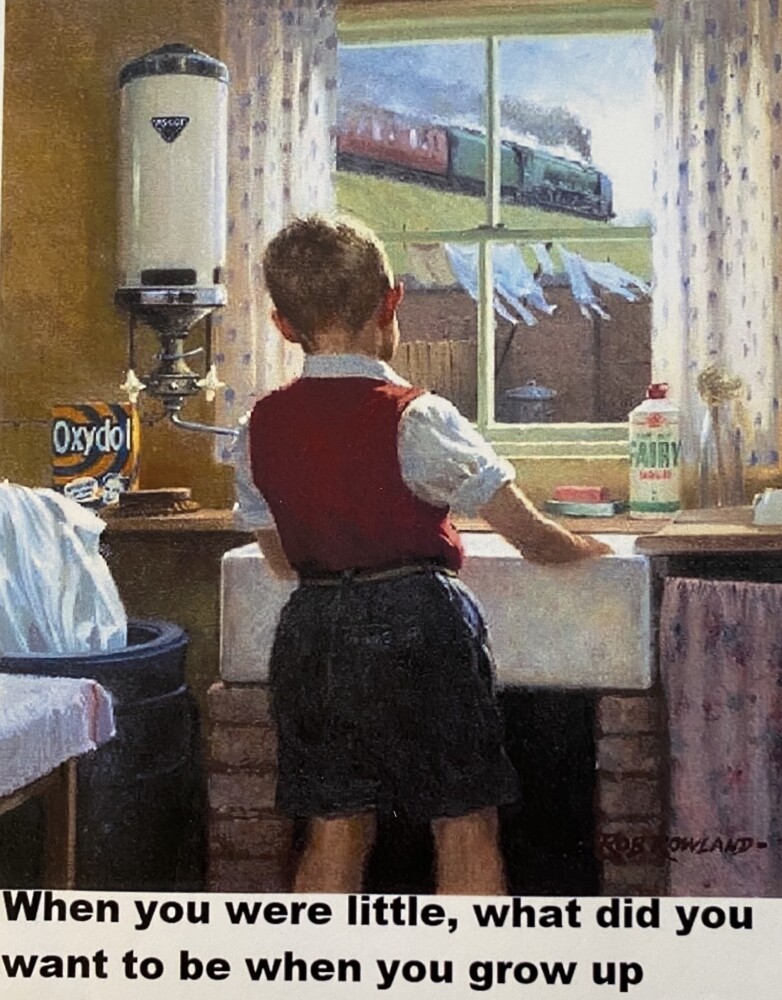
"When I was small, all boys wanted to be an Engine Driver. We had the Ian Allen ABC books for the railways but we were in Great Western territory. Gresford village sitting just above Gresford bank on the Birkenhead (Woodside) to Paddington main line was where we watched everything but a King steam by. Somebody in the morning would pick out a 'namer' as it went down and the word went around school that something famous such as '5069 Isambard Kingdom Brunel' was on the 'Birk' (Birkenhead) and everybody would be there on the 'Blackie Bridge' to see her returning up the bank on the 'up line' after school.
"A cousin of my Mum's worked at Wrexham General Station as a porter or as station staff and he took me to see the shed manager at Croes Newydd when I left school and that was it, I was now Great Western forever."
Starting Out / Dechrau Allan

"I started work at the age of 15 in January 1952. If you wanted to become a driver, you started at the bottom as a cleaner, moving up through the roles of Fireman, a Passed Fireman and later a Driver.
As a young lad cleaning on nights, we were called on to go and wake early Drivers so they would be early to the shed. Some lived in the terraced houses next to the shed.
I learned to fire when I was 15 and used to go on a Saturday afternoon to Barmouth with Driver 'Tiger' Smith, Fireman Percy Rodgers and that helped.
To get on, you needed to go to work in a bigger shed and I went to Tyseley in Birmingham. I moved back to Croes Newydd when a vacancy came up a couple of years later."
Llangollen Memories / Atgofion Llangollen

"We used to work the special trains for the Eisteddfod at Llangollen from Wrexham and back. At times the parcels from Cuthbert's Seeds were sent all over Britain by the Railway from Llangollen.
I used to see all my mates at the back of the Sarah Ponsonby pub in Llangollen with a big pint and a grin as I went past. The line ran at the back of the pub and coming back from Barmouth I was on the Fireman's side of the cab as I leaned out facing the pub and my mates. That cold beer always looked nice on a hot summer's day!"
Berwyn Tunnel / Tunnel Berwyn

"I worked with a driver who was a bit of a practical joker. I thought to myself that I would get him back somehow. One day when we were going to Barmouth, we came through Berwyn on the climb up the bank and I though 'I know how to get him back'. I'd got the fire, water and steam right before the tunnel and I stood on my side of the cab with the shovel in my hand. When we ran into the runnel and in the dark, I slowly put the shovel down and stepped to the back of the cab and I wasn't there. He panicked and went for the regulator before realising I was behind him. It gave him such a fright. He said 'you shouldn't do that to me' but I had made my point and he didn't play jokes on me again."
Corwen Memories / Atgofion Corwen
"Auntie Ellen kept a Fish and Chip shop in Corwen on the main road, wet fish in the morning with deliveries to houses and fish and chips after. We would holiday in Corwen. My Mum, Lottie, used to work there while we were on holiday. Dad's sister and husband, Ellen and Ernest Owen owned the shop in the town. We, my sisters Chris and Dot, my cousins Elwyn and Bernard used to play by the River Dee or up the mountain at the back. By the post there was a footprint which was said to be Owen Glyndwr's. And once, when I was about 8 years of age, we were leaning on the railings looking across the valley and 4 Spitfires flew along the valley and we were higher than those planes looking down on them.
I didn't know then that I would work this line one day. I did fire the Corwen to Rhyl line once. We took a school party from Bala to the seaside and sat on a siding ready to bring them back later."
Welsh Language Changes / Newidiadau Iaith Gymraeg
One interesting fact is that no Welsh language speakers were officially to be employed on Welsh railways until as recently as the early 1960s. This was because the railways were run by companies that hired English speakers in order that they would be able to operate across the entire lines that ran over the border and into England. Local Welsh-speaking men seeking work often lied on their application forms and in interviews by saying that they did not speak Welsh even though it was actually their first language. Had they not done so, it was unlikely that they would be employed. Once they had the job, there was no problem with them carrying out the work but they needed to be careful not to shout a Welsh greeting to a friend or family member if they saw them onboard a train.
Thank you / Diolch
We would like to thank the following for their assistance in the creation of this book:
National Lottery Heritage Fund
Tom Taylor
Peter Dickinson
Alex Elbourne
Bob Gwynne
John Mason
Bob Jacques
John Rutter
Seana McGarry
Paul Evans and the archive of John Evans
Dave Owen
Passengers on the Santa and Mince Pie Specials on 20th and 28th December 2024
Visitors and volunteers/staff at the Branch Line Gala day on 11th April 2025
Sam Birchall
Richard Knew
Martyn Chidlow
Aaron O'Carroll
Joanne Crompton
Chris Hopley
Russel Dunn
John Roberts
Bernard Allman
Peter Neve
David Tyrer
D Evans Catering Services
Fineline Printing and Stationery
Kathy Barham, Dilwyn Jones, Julie Masters and Debbie Hollingworth (Book of You)
This content is licensed under CC BY 4.0 / Mae'r fideo wedi'u trwyddedu o dan CC BY 4.0